Why Vinyl Record Grading Matters
If you collect vinyl records, condition is everything. Two copies of the same pressing can differ wildly in value depending on how they have been stored, handled, and played over the decades. A Near Mint first pressing of a classic album might sell for hundreds of dollars, while a scratched-up copy of the same record barely fetches a few bucks at a garage sale.
But value is not the only reason grading matters. Condition directly affects the listening experience. Surface noise, pops, clicks, and distortion all stem from wear and damage. And when you are buying, selling, or trading records, a shared grading language ensures fairness on both sides of the transaction. That is where the Goldmine grading scale comes in.
The Goldmine Grading Scale Explained
The Goldmine grading scale is the industry-standard system for describing vinyl record condition. Originally developed by Goldmine magazine, it is now used universally by collectors, record stores, and online marketplaces like Discogs. Understanding this scale is essential whether you are listing a record for sale, evaluating a potential purchase, or simply cataloging what you own.
Here is a quick reference before we dive into each grade:
| Grade | Abbr. | What to expect |
|---|---|---|
| Mint | M | Perfect and unplayed. Still sealed. Flawless in every way. |
| Near Mint | NM / M- | Nearly perfect. Played carefully, no audible defects. Cover has no visible wear. |
| Very Good Plus | VG+ | Light surface marks. Occasional soft clicks. Cover shows minor wear. |
| Very Good | VG | Noticeable surface noise and light scratches. Cover shows moderate wear. |
| Good Plus | G+ | Significant noise, scratches, possible light warping. Heavy cover wear. |
| Good | G | Heavy wear and scratches. Listening copy only. Cover heavily damaged. |
| Fair / Poor | F / P | Barely playable or unplayable. Severe damage. Placeholder value only. |
Now we break down each grade so you know exactly what to look and listen for.
Mint (M)
A Mint record is absolutely perfect. Unplayed and still in its original shrink wrap or seal. There are no surface marks, no scuffs, and no imperfections of any kind. The cover, inner sleeve, and any inserts are equally flawless. In practice, Mint is rarely used for opened records because even removing the shrink wrap introduces the possibility of minor handling marks. If a seller describes an opened record as Mint, approach with caution.
Near Mint (NM or M-)
Near Mint is the highest realistic grade for a record that has been opened and possibly played. The vinyl shows no visible surface marks under normal lighting. If it has been played, it was done so carefully. No audible clicks, pops, or distortion. The cover is crisp with sharp corners, no ring wear, and no writing. This is the gold standard for used records, and it is what serious collectors aim for when buying high-value pressings.
Very Good Plus (VG+)
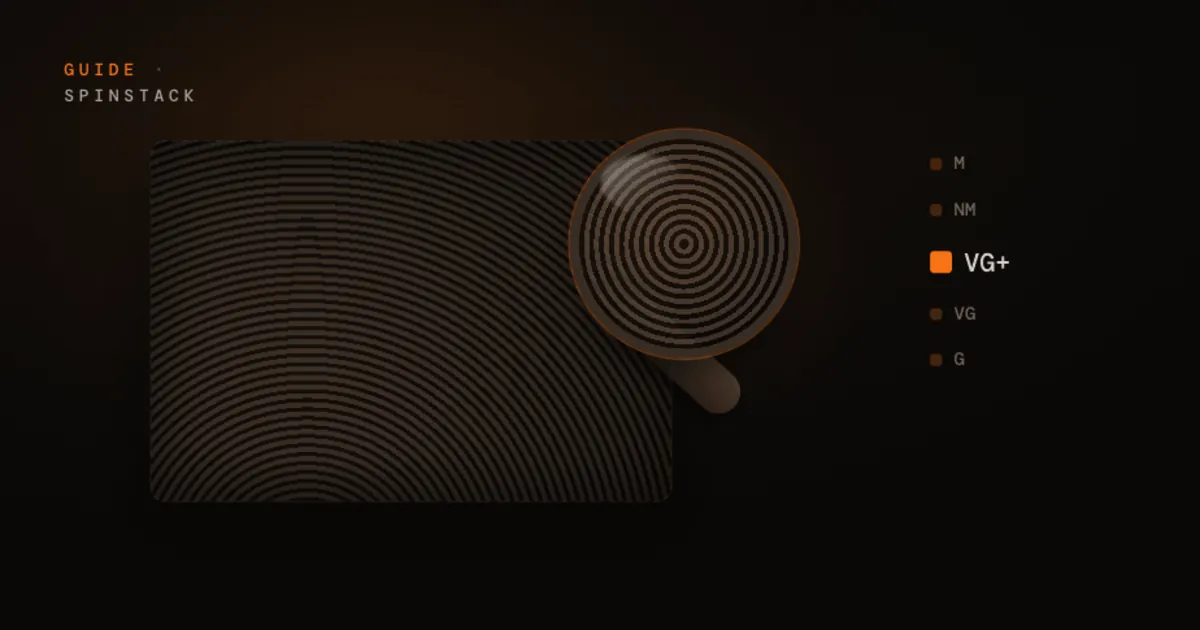
VG+ records show light surface marks that are visible under direct light but do not cause significant audible issues. You might hear an occasional soft click or pop during quiet passages, but the overall listening experience remains excellent. The cover may show light ring wear from the record pressing against the jacket, slight edge wear, or a minor crease. For most collectors, VG+ represents the sweet spot. The record sounds great and typically costs significantly less than Near Mint. For a complete breakdown of VG+ pricing, buying strategy, and how sellers inflate this grade, see our deep dive into what VG+ actually means.
Very Good (VG)
At VG, you will notice surface noise throughout playback. A consistent light crackle or hiss, especially during quieter sections. Light scratches are visible, but groove damage is minimal, meaning the record tracks properly and plays through without skipping. The cover shows moderate wear: ring wear, edge splits beginning to form, light foxing, or minor writing. A VG record is still perfectly enjoyable to listen to, and for common titles it can be a smart purchase at a fraction of NM pricing.
Good Plus (G+)
G+ records have significant surface noise that is audible throughout playback. Scratches are clearly visible, and you may notice light warping. The record still plays through without major skipping, but the listening experience is noticeably compromised. The cover has heavy wear: seam splits, writing, sticker residue, water damage, or significant ring wear. G+ records are best suited for casual listening or as placeholders until you find a better copy.
Good (G)
A Good record has heavy wear across the playing surface. Deep scratches, significant surface noise, and possible groove damage make this a "listening copy" at best. The cover is heavily damaged. Torn, water-stained, or barely intact. The only real appeal of a G record is that it plays through (mostly), and for rare or expensive titles, it might be the most affordable way to own the music on vinyl while you search for an upgrade.
Fair (F) and Poor (P)
Fair and Poor records are at the bottom of the scale. They may skip, have deep gouges, severe warping, or be cracked. Playback ranges from painful to impossible. These grades exist primarily as documentation. A record graded F or P has value only as a placeholder in a collection or, in extremely rare cases, as the only known copy of a particular pressing. You should almost never pay for a record in this condition unless it is truly irreplaceable.
Record Grade vs. Sleeve Grade
One of the most important conventions in vinyl record grading is the dual-grading system. Because the disc and its packaging wear independently, they are graded separately. You will see this written as two grades separated by a slash. For example, VG+/VG means the vinyl itself is in Very Good Plus condition while the sleeve is Very Good.
The first grade always refers to the record; the second refers to the cover. Some sellers go further, noting the condition of inner sleeves, lyric sheets, posters, and other inserts separately. When buying, always look for both grades. A listing that only gives one grade is ambiguous. You do not know if it applies to the disc, the cover, or both.
Keep in mind that the cover often shows more wear than the disc, especially if the record was stored upright in a dry environment. Conversely, a pristine cover can hide a well-worn disc. The dual-grade system exists precisely because you cannot assume one from the other.
How to Grade a Vinyl Record at Home
Grading records accurately takes practice, but these practical tips will help you develop a reliable eye and ear for condition assessment.
Visual inspection
- Use a strong, angled light source. Hold the record under a bright lamp and tilt it slowly. Surface marks, hairline scratches, and scuffs become visible as the light catches them at different angles. Overhead fluorescent lighting can hide imperfections that a desk lamp reveals easily.
- Handle the record by its edges and label only. Fingerprints introduce oils that attract dust and can cause noise over time. Proper handling also prevents you from adding new marks during inspection.
- Check for warping. Place the record on a flat surface and look for any wobble or lift. You can also hold it at eye level and sight across the surface. Even a slight warp will be visible in profile. Minor warps may not affect playback, but significant warping causes tracking issues.
Play test
- Use a clean, properly aligned stylus. A worn or dirty needle can make a good record sound worse than it is. Clean your stylus before every grading session.
- Listen for pops, clicks, and distortion. Play the record all the way through if possible. Pay special attention to quiet passages and the inner grooves near the label, where distortion tends to be more pronounced.
- Note any skipping or repeating. A record that skips, even once, cannot be graded higher than Good, regardless of how it looks visually.
Sleeve inspection
- Ring wear: Circular impressions on the cover caused by the record pressing outward. Common on gatefolds and thin jackets.
- Seam splits: Check all edges where the cover is glued. Small splits are expected on older records; full-length splits significantly lower the grade.
- Writing, stickers, and cut corners: Name writing, price stickers, radio station stamps, and cut-out notches all affect the sleeve grade. Cut corners and drill holes indicate the record was a promotional or remaindered copy.
Grading Tips for Buyers
Whether you are browsing crates at a local shop or scrolling through listings online, knowing how to interpret grading descriptions will save you money and disappointment.
- VG+ is the sweet spot. For most collectors, VG+ offers the best balance of sound quality and price. You will get an excellent listening experience at a significant discount compared to Near Mint, especially on sought-after pressings.
- Be wary of vague descriptions. Listings that say "good condition" without using Goldmine grades are a red flag. "Good" in casual language means something very different from "Good" on the Goldmine scale. The latter actually indicates heavy wear.
- Ask for photos. When buying online, request close-up images of the playing surface under strong light, as well as photos of the cover edges and seams. Reputable sellers are happy to provide them.
- Conservative grading is a good sign. Sellers who grade conservatively tend to be more trustworthy. If a seller consistently grades at VG+ and the records arrive looking closer to NM, you have found a reliable source.
- Factor in cleaning. A VG record that is merely dirty can often be upgraded to VG+ or better with a proper wet clean. Surface noise caused by dust and grime is fixable. Scratches and groove damage are not.
Tracking Vinyl Record Grades in Your Collection
Once you start grading your records, you will want a system to track that information alongside the rest of your collection data. Keeping condition notes on paper or in a spreadsheet works, but it is easy to lose context when your collection grows past a few hundred records.
Spinstack makes this straightforward. You can set a condition grade for every record in your collection, using the standard Goldmine scale. Filter and sort your entire library by condition to quickly find your best copies, identify records that need upgrading, or pull together a list of records you are ready to sell. If you use Discogs, Spinstack syncs your grades both ways. Update a grade in the app and it reflects on your Discogs profile, and vice versa.
Having your collection's condition data in one place also helps you make smarter buying decisions. When you are at a record fair and spot a copy of an album you already own, a quick check in Spinstack tells you whether your current copy is VG or NM. You know instantly whether the upgrade is worth it. The app runs on iPhone, iPad, Mac, and Apple TV, so your collection is always accessible regardless of which device is closest.